10 Best Chocolate Making Machines to Buy in 2026?
Choosing a Chocolate Making Machine in 2026 means matching equipment to real production needs, not simply buying the largest model. A small tempering unit may suit a pastry kitchen, while a bean-to-bar workshop may need a grinder, melanger, and tempering system. Capacity matters. So does control.
Chocolate expert and pastry chef Alice Medrich is often quoted as saying, “Chocolate is a food, not a candy.” That idea fits machine selection: chocolate responds to heat, movement, and timing. A display showing a stable tempering temperature is useful, but operators should also check batch consistency, cleaning access, spare parts, and service support. Look for practical details, such as a removable bowl that can be cleaned without awkward reaching or a control panel that remains readable beside a warm production line.
This guide compares ten machines available to buyers in 2026, from compact countertop models to equipment built for larger batches. It considers output, temperature precision, ease of use, and the work each machine is designed to handle. No single choice fits every kitchen. Even a capable machine cannot replace careful testing, and product details can change between model years. That deserves a second look. Use the comparisons to narrow your options, then confirm current specifications, warranty terms, and local support before purchasing. A machine that looks impressive online may feel very different after hours of cleaning and production.
Understanding Chocolate-Making Machines and Their Main Functions
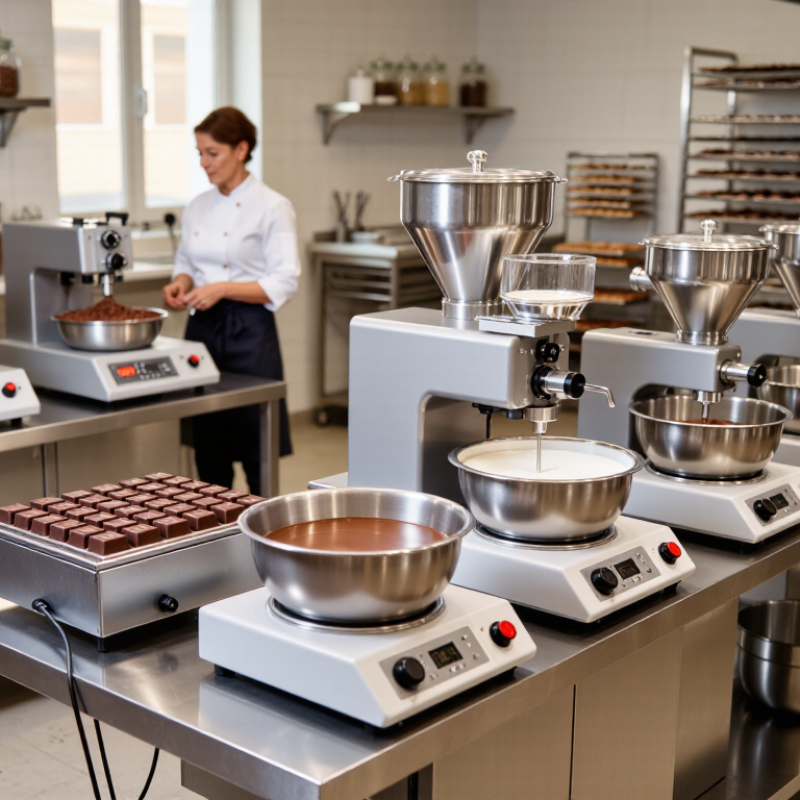
Chocolate-making machines handle different stages, and one unit rarely performs every task equally well. A melter warms chocolate gently and keeps it fluid for processing. A tempering machine controls heating and cooling so cocoa butter forms stable crystals. This helps finished pieces look glossy and break cleanly. It matters.
Grinders and refiners reduce particles in ingredients such as cocoa nibs and sugar. Their settings affect texture: a coarse result can feel sandy, while extended refining produces a smoother paste. Depositors portion chocolate into molds, and enrobers coat centers such as biscuits or fruit. Larger operations may use cooling tunnels to set products evenly. For a small kitchen, a separate tempering unit and simple molds may be more practical than a full production line.
When comparing machines, check batch capacity, temperature accuracy, cleaning access, and the space needed around the equipment. A machine rated for a large batch may not work well with a small amount. Scrape the bowl, inspect seams, and consider how quickly parts can be washed between recipes. I may be overvaluing automation here; for occasional batches, careful manual work can be easier to manage. The right setup depends on the chocolate, recipe, and production pace.
10 Best Chocolate Making Machines to Buy in 2026? — Understanding Chocolate-Making Machines and Their Main Functions
Chocolate-making machines perform different tasks, from melting and tempering to mixing and enrobing. This chart shows representative midpoint temperatures for the three stages of dark chocolate tempering: heating, cooling, and reheating. Typical working ranges are approximately 45–50°C, 27–28°C, and 31–32°C, respectively; exact temperatures vary with the chocolate formulation.
Machine Types for Home, Artisan, and Commercial Chocolate Production
In 2026, the right chocolate-making machine depends less on its feature list than on the batch size and process you need. Home makers can start with a melanger for refining small quantities of cacao and sugar. Check its bowl capacity, cleaning requirements, and whether it can run for extended periods. Small batches matter. Capacity isn’t everything.
Artisan production often needs separate equipment for refining, tempering, and molding. A tabletop tempering machine can help maintain a workable chocolate temperature, while a reliable thermometer lets you check results rather than trust a display alone. Look for parts that are easy to clean and controls that suit your usual batch size. A machine that is too large may waste space and energy. That trade-off is easy to underestimate.
Commercial production calls for higher throughput, consistent temperature control, and equipment built for repeated use. Continuous tempering systems can support larger workflows, but they need enough room, power, and trained operators. Before buying, compare stated capacity with your actual production schedule, and ask how routine cleaning and servicing are handled. The highest output may not fit your needs. A smaller, well-matched setup can be more practical.
10 Best Chocolate Making Machines to Buy in 2026? – Machine Types for Home, Artisan, and Commercial Chocolate Production
| Machine type | Typical capacity or output | What it does | Best suited to | Key buying checks |
|---|---|---|---|---|
| Small stone melanger | About 1–5 kg per batch; refining commonly takes 24–72 hours, depending on the recipe and target texture. | Refines and mixes cocoa nibs, sugar, and other ingredients using rotating stone rollers. | Home makers and small bean-to-bar batches. | Check minimum batch size, bowl and roller materials, cleaning access, and whether the motor is rated for long operating periods. |
| Tabletop ball-mill refiner | Often around 5–20 kg per batch for small production units; processing time varies with formulation and fineness target. | Reduces particle size through milling media, producing a smooth chocolate mass. | Artisan makers seeking faster batch refining than many small melangers provide. | Confirm food-contact materials, cooling arrangements, discharge method, and the manufacturer’s recommended batch range. |
| Cocoa bean roaster | Small roasters commonly handle a few kilograms per batch; roasting time and load depend on bean size, moisture, and roast profile. | Applies controlled heat to develop flavor and prepare cocoa beans for cracking and winnowing. | Bean-to-bar makers and chocolate workshops that roast their own beans. | Look for adjustable temperature and airflow, even heat distribution, batch repeatability, and suitable ventilation. |
| Cocoa bean winnower | Small equipment may process roughly 1–5 kg of beans per hour; actual yield depends on the beans and settings. | Separates cocoa nibs from the lighter husk after beans have been cracked. | Small-scale bean-to-bar production. | Check crack-size adjustment, nib recovery, dust control, and compatibility with the output of your cracker. |
| Chocolate melter or holding tank | Tabletop models often hold several kilograms; larger tanks are available for production lines. | Melts and holds chocolate at a controlled temperature. A melter alone does not temper chocolate. | Home kitchens, bakeries, and artisan shops needing a ready supply of melted chocolate. | Check temperature control, tank capacity, cleanability, and whether the unit uses gentle indirect heating. |
| Tabletop tempering machine | Many small units have a working bowl of a few kilograms; output depends on the machine and operating method. | Controls heating, cooling, and working temperatures to prepare chocolate for molding or coating. | Home chocolatiers and small artisan businesses. | Compare minimum working load, temperature stability, cleaning time, and the chocolate types supported. |
| Continuous tempering machine | Small production models may process tens of kilograms per hour; larger systems are designed for higher continuous output. | Continuously tempers chocolate and supplies it to molding, coating, or enrobing equipment. | Busy artisan workshops and commercial production lines. | Match rated output to downstream equipment; verify temperature control, cleaning procedures, and available electrical supply. |
| Chocolate depositor | Hopper size, deposit weight, and cycle speed vary widely across tabletop and production models. | Dispenses measured portions into molds, trays, or product cavities. | Makers producing repeatable bars, pralines, shells, or filled products. | Check portion accuracy, nozzle options, mold compatibility, and whether the depositor handles inclusions or multiple deposit sizes. |
| Chocolate enrober | Compact units are intended for low-to-moderate production; practical throughput depends on belt width, product size, and coating thickness. | Coats centers such as biscuits, nuts, or confectionery with a controlled layer of chocolate. | Artisan shops and businesses making coated products regularly. | Review belt width, coating control, bottoming and tailing functions, cleaning access, and tempering-machine compatibility. |
| Chocolate cooling tunnel | Capacity depends on tunnel length, belt width, belt speed, product spacing, and cooling conditions. | Cools molded or enrobed chocolate in a controlled environment to help it set. | Commercial and high-volume artisan lines. | Check footprint, adjustable airflow and temperature, belt speed, humidity management, and alignment with upstream and downstream equipment. |
Capacity figures are indicative ranges for equipment categories, not guaranteed specifications. Actual performance varies by model, recipe, operating conditions, and product format; confirm the rated working range with the equipment supplier before purchasing.
How to Compare Capacity, Temperature Control, and Build Quality
A useful comparison starts with usable capacity, not the largest number printed in a product listing. A machine may hold several kilograms, yet small batches can sit unevenly around the stirring blade. Consider how much chocolate you actually expect to temper at once, and whether the bowl can handle that amount without splashing or leaving unmelted pieces. Capacity matters. Check whether the maker explains its recommended working range, not just its maximum volume.
Temperature control deserves close attention because a display reading is not necessarily the chocolate’s exact temperature. Look for clear adjustment increments, steady heat, and instructions for checking temperature with a separate thermometer. Heat is unforgiving. A small overshoot can affect texture and shine, while slow recovery after adding cool chocolate can disrupt a batch. It is worth asking how quickly the machine responds, though published specifications do not always make this easy to compare.
Build quality shows up in details you can inspect: a stable base, a well-fitting lid, smooth bowl seams, and a stirring mechanism that does not wobble under a full load. Removable parts may make cleanup simpler, but only if they are practical to lift and reassemble. Feel the machine. Some buyers may prefer heavier construction; others may value easier storage. Neither choice is automatically better, and advertised durability can be difficult to verify without long-term use.
Ten Chocolate-Making Machines to Consider Buying in 2026
Ten machines to consider in 2026 cover different stages of chocolate production. A cocoa roaster, winnower, nib grinder, pre-refiner and five-roll refiner prepare the chocolate base. A conche, tempering unit, moulding depositor, enrober and cooling tunnel shape, finish and cool it. Not every workshop needs all ten.
Capacity deserves close attention. The International Cocoa Organization’s 2023/24 statistics report about 4.8 million tonnes of global cocoa grindings, a useful industry-scale reference but not a small-business forecast. Grand View Research valued the global chocolate market at about $119.4 billion in 2023 and projected 4.8% annual growth through 2030. These figures suggest ongoing demand, but they cannot tell buyers which machine will suit their recipes.
Compare batch size, temperature control, cleanability and service access before buying. A tempering unit with steady heat control can help prevent dull, streaked shells; a cooling tunnel needs enough room for the moulds you actually use. Ask suppliers for test runs with your own chocolate, not just a polished demonstration. This shortlist is imperfect. Production space, operator skill and recipe all change the result. A larger machine may look efficient on paper, yet sit idle between small batches.
Choosing and Maintaining a Machine for Your Chocolate-Making Needs
Choosing a chocolate-making machine starts with the batch size you actually need. A compact melanger may suit small test batches, while a tempering machine can help maintain consistent working temperatures during repeated pours. Check the bowl capacity, temperature controls, cleaning access, and available counter space. A machine that looks powerful may still be awkward to use if its parts are difficult to remove. Listen for noise, too; a loud motor can become tiresome during longer sessions.
Tips: Match capacity to your usual recipes, not an occasional large batch. Keep a simple log of temperatures and results. Chocolate type and room conditions can affect tempering, so follow the machine’s instructions and verify settings with a thermometer.
Regular care helps prevent uneven mixing and avoidable wear. Unplug the machine before cleaning, and keep water away from electrical components. Remove chocolate residue while it is still manageable, using tools suited to the maker’s cleaning guidance. Inspect removable seals, belts, or stirring parts for wear, and let components dry fully before reassembly. Don’t force a stuck part. I’ve found that rushed cleanup can make the next batch harder, though some dried spots still take patience. Keep the manual nearby, especially when adjusting temperature settings or replacing parts.
Related Posts
-
What Makes the Best Chocolate Manufacturing Machine Essential for Your Business
-

2026 Top Chocolate Processing Machine Trends and Innovations?
-

2026 Top Chocolate Grinding Machine Types Buyers Need
-
China's Intelligent Chocolate Machines Redefining Global Quality Standards
-

Understanding the Essential Specifications of Chocolate Tempering Equipment for Global Buyers
-
How to Choose the Best Chocolate Processing Machine for Your Production Needs